Expanded metal mesh thickness is a critical factor across numerous industries, impacting everything from structural integrity and material efficiency to filtration performance and aesthetic appeal. Understanding the nuances of expanded metal mesh thickness – how it’s measured, the implications of different gauges, and the optimal choice for specific applications – is paramount for engineers, architects, and manufacturers alike. Its relevance extends beyond simply choosing a product; it directly influences project success, longevity, and ultimately, cost-effectiveness.
Globally, the demand for expanded metal mesh is steadily increasing, driven by growth in construction, automotive, and industrial sectors. According to recent reports, the global expanded metal market is projected to reach \$[Insert realistic market value] by [Insert year], reflecting a compound annual growth rate of [Insert realistic percentage]. This surge is fueled by the material’s versatility, durability, and recyclability. However, inconsistent manufacturing standards concerning expanded metal mesh thickness pose a significant challenge for buyers seeking reliable and consistent performance.
The increasing emphasis on sustainability also elevates the importance of optimized material usage, and expanded metal mesh, when produced with appropriate thickness, minimizes waste compared to conventional metal processing techniques. It’s a key component in modern infrastructure and increasingly important in disaster relief efforts, highlighting its far-reaching impact.
Introduction to expanded metal mesh thickness
Understanding expanded metal mesh thickness goes beyond simply knowing the gauge of the metal. It encompasses the relationship between the original sheet metal’s thickness, the size and pattern of the openings created during the expansion process, and the resulting mechanical properties of the mesh. Thicker base metal generally yields a more robust and durable mesh, while thinner metal offers greater flexibility and lighter weight.
Choosing the appropriate expanded metal mesh thickness is critical for ensuring structural integrity, load-bearing capacity, and overall performance in its intended application. Failure to select the correct thickness can lead to premature failure, safety hazards, and increased maintenance costs. Proper consideration of expanded metal mesh thickness is a cornerstone of efficient and reliable design.
Defining expanded metal mesh thickness
Expanded metal mesh thickness refers to the original thickness of the metal sheet before the expansion process. It is typically measured in gauges (American Wire Gauge - AWG) or millimeters. The gauge number inversely correlates to thickness; a lower gauge number indicates a thicker material. It's crucial to note that the expansion process itself doesn't change the metal’s thickness, but it redistributes the material to create openings, affecting its overall strength and weight.
The significance of understanding expanded metal mesh thickness stems from its direct impact on the mesh’s load-bearing capacity, stiffness, and resistance to deformation. In critical applications like walkways, stair treads, or protective barriers, the correct thickness is paramount to ensure safety and prevent structural failure. expanded metal mesh thickness choices need thorough consideration.
This definition links directly to modern industrial design and infrastructure needs. Engineers use this understanding to optimize material usage, reducing costs and weight without compromising performance. In humanitarian contexts, appropriately-gauged expanded metal can provide robust and long-lasting shelters and infrastructure in disaster zones.
Core Factors Influencing expanded metal mesh thickness
Several factors influence the ideal expanded metal mesh thickness for a given application. Load Capacity is paramount – heavier loads require thicker materials to prevent bending or breakage. The intended span between supports also dictates thickness; larger spans necessitate more robust mesh.
Corrosion Resistance is another crucial factor. While the metal alloy itself determines inherent resistance, thicker materials provide a greater barrier against corrosive elements. The environment the mesh will be exposed to – salt spray, industrial chemicals, or humid climates – dictates the appropriate thickness and potentially the alloy choice.
Aesthetic Considerations also play a role. Thicker mesh often presents a more substantial and visually appealing look, particularly in architectural applications. Cost is inevitably a factor; thicker materials generally cost more. Balancing performance requirements with budgetary constraints is a common engineering challenge. Finally, Manufacturing Limitations may restrict the maximum achievable thickness depending on the expansion process and available equipment.
Applications of Specific expanded metal mesh thickness
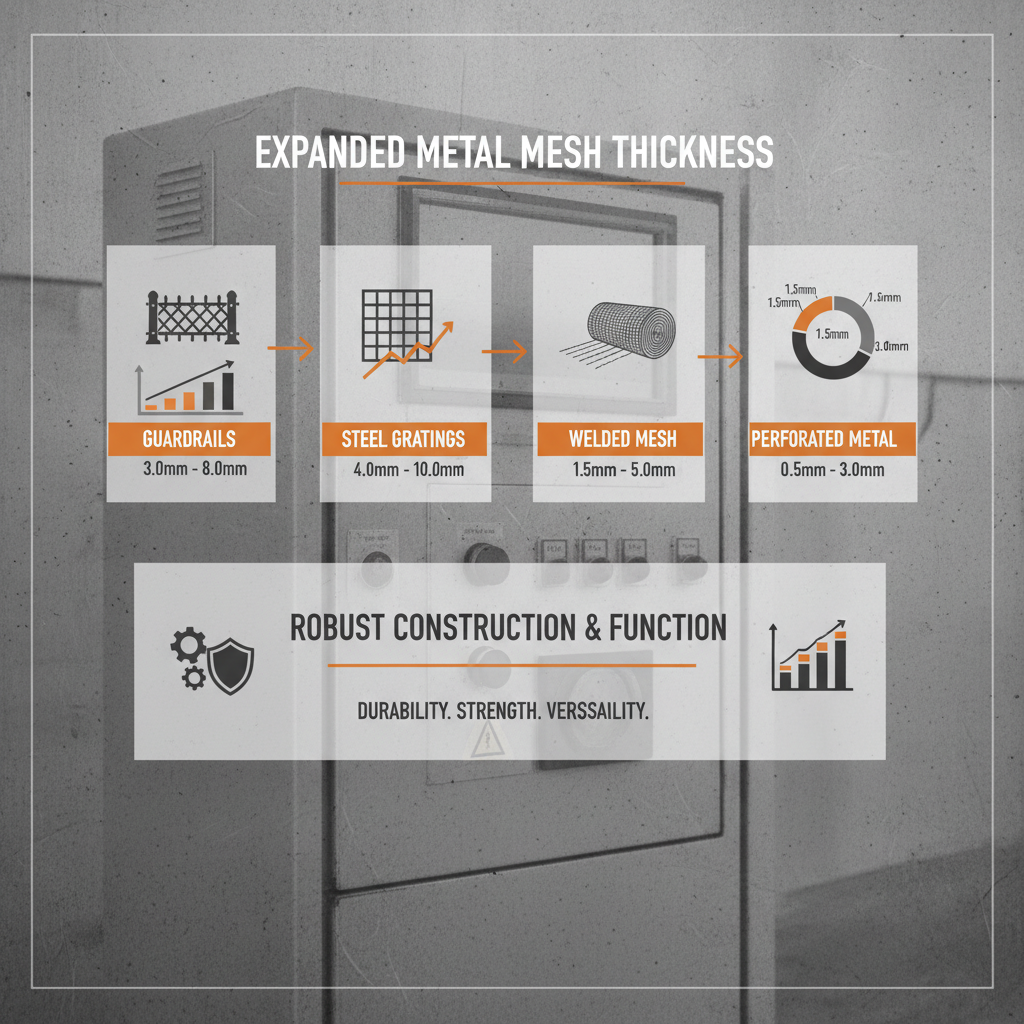
Different industries demand varying expanded metal mesh thicknesses based on their specific needs. For example, architectural applications frequently employ a lighter gauge (e.g., 16-20 AWG) for facades and decorative elements where aesthetics and weight are primary concerns. Conversely, industrial flooring and stair treads typically require a much thicker gauge (e.g., 8-12 AWG) to withstand heavy foot traffic and potential impacts.
The filtration industry utilizes expanded metal mesh of varying thicknesses depending on the particle size being filtered. Coarse filtration might employ a relatively thicker mesh with larger openings, while fine filtration demands a thinner mesh with smaller, more precise openings.
expanded metal mesh thickness and Application Suitability
Global Applications and Use Cases
Expanded metal mesh, with its specific thickness characteristics, finds application across a broad spectrum of global industries. In post-disaster relief operations, for example, expanded metal walkways provide stable and safe pathways over debris, and thicker gauge mesh is often utilized for temporary shelters.
In remote industrial zones like mining operations in Australia or oil refineries in the Middle East, expanded metal mesh flooring ensures safe and durable work surfaces, even in harsh environments. The chosen expanded metal mesh thickness will depend on the expected weight loads from machinery and personnel.
The architectural sector in Europe and North America frequently employs expanded metal mesh as a decorative cladding material for buildings, with thinner gauges offering aesthetic appeal and lighter weight. expanded metal mesh thickness is also seen in transportation, as it forms robust grilles for ventilation systems in vehicles.
Advantages of Optimized expanded metal mesh thickness
Selecting the optimal expanded metal mesh thickness yields numerous advantages. Cost Efficiency is a primary benefit – using the appropriate thickness minimizes material waste and avoids over-engineering, leading to lower project costs. Enhanced Durability translates to a longer service life, reducing the need for frequent replacements and minimizing long-term maintenance expenses.
Optimized thickness also contributes to Improved Safety, ensuring structural integrity and preventing failures that could lead to injuries or accidents. Furthermore, the right thickness can enhance Aesthetic Appeal, offering a visually pleasing and professional finish.
Future Trends in expanded metal mesh thickness
Future trends in expanded metal mesh thickness are closely tied to advancements in material science and manufacturing techniques. Research into high-strength, lightweight alloys is driving the development of thinner, yet more durable, expanded metal mesh options. This aligns with the growing demand for sustainable building materials and reduced carbon footprints.
Digital transformation and automation are also playing a significant role. Computer-aided design (CAD) and computer-aided manufacturing (CAM) technologies enable precise control over the expansion process, resulting in consistent thickness and improved product quality. These innovations will enable customized expanded metal mesh solutions tailored to specific application requirements.
Further developments in green energy and infrastructure projects will likely see increased demand for expanded metal mesh with specialized coatings and thicknesses to withstand harsh environmental conditions and provide long-term reliability.
Challenges and Solutions
One key challenge is maintaining consistent expanded metal mesh thickness across large production runs, particularly with varying metal alloys and thicknesses. Inconsistent thickness can lead to performance issues and quality control problems. Another challenge arises from accurately assessing the required thickness for complex applications, where multiple load conditions and environmental factors must be considered.
Solutions include implementing advanced quality control systems with laser scanning technology to monitor thickness variations in real-time. Utilizing finite element analysis (FEA) software allows engineers to simulate stress distribution and optimize thickness for specific applications. Investing in skilled technicians and training programs ensures consistent manufacturing processes and accurate quality assessments.
Standardization of measurement methods and reporting protocols within the expanded metal mesh industry can also contribute to improved quality control and customer satisfaction.
Overview of expanded metal mesh thickness challenges and solutions
| Challenge |
Impact on expanded metal mesh thickness |
Solution |
Implementation Cost (1-10) |
| Thickness Inconsistency |
Reduced structural integrity; compromised performance. |
Laser Scanning Quality Control |
7 |
| Incorrect Thickness Selection |
Premature failure; safety hazards. |
Finite Element Analysis (FEA) |
6 |
| Material Variability |
Inconsistent mechanical properties. |
Strict Supplier Qualification |
5 |
| Lack of Standardization |
Difficulty in comparing products. |
Industry-Wide Standards Development |
8 |
| Skill Gap in Manufacturing |
Poor expansion process control. |
Technician Training Programs |
4 |
| Environmental Corrosion |
Reduced lifespan; structural weakening. |
Protective Coatings Application |
5 |
FAQS
The most common gauge expanded metal mesh used in general construction typically falls within the range of 14-16 AWG. This provides a good balance between strength, cost-effectiveness, and workability. However, specific applications, such as flooring or stair treads, may require thicker gauges (e.g., 10-12 AWG) to ensure adequate load-bearing capacity and safety. The optimal choice depends on the anticipated loads and the intended use case.
Expanded metal mesh thickness is directly proportional to its weight. A thicker gauge metal sheet will result in a heavier mesh, even after expansion. This is an important consideration in applications where weight is a critical factor, such as in the aerospace industry or in portable structures. Selecting a thinner gauge material can reduce weight, but may compromise strength and durability, requiring careful evaluation.
’Short rib’ and ‘long rib’ refer to the orientation of the raised ridges after expansion. Long rib expanded metal typically offers greater strength in one direction, requiring careful consideration of load direction. Short rib generally provides more uniform strength. Thickness considerations remain similar, but long rib might allow for slightly thinner materials for a given strength requirement in the longitudinal direction, as the ribbing itself adds structural support.
No, the expanded metal mesh thickness itself cannot be altered after the expansion process. The expansion process redistributes the material, creating openings, but it doesn't change the original thickness of the metal. However, additional treatments like galvanizing or powder coating can increase the overall thickness slightly, but this is a surface treatment, not a change in the base metal thickness. Selecting the correct initial thickness is crucial.
Different materials have varying tensile strengths and yield points. For example, stainless steel generally requires a thinner gauge than carbon steel for equivalent strength due to its superior inherent strength and corrosion resistance. Aluminum will require even greater thickness to achieve comparable strength. The optimal thickness will always be determined by the specific material properties and the application’s load requirements.
Using expanded metal mesh with an insufficient thickness can lead to several serious consequences. These include structural failure under load, bending or deformation, reduced lifespan, increased maintenance costs, and, most importantly, safety hazards. In critical applications, like walkways or safety barriers, insufficient thickness could result in injuries or accidents. Thorough engineering analysis is crucial to determine the appropriate thickness for any given application.
Conclusion
In conclusion, understanding expanded metal mesh thickness is fundamental to successful engineering design and material selection. Its impact spans across numerous industries, influencing structural integrity, cost-effectiveness, safety, and sustainability. Proper consideration of factors like load capacity, corrosion resistance, and intended application is critical for optimizing performance and ensuring long-term reliability.
Looking ahead, advancements in materials science and manufacturing technologies will continue to refine our ability to produce expanded metal mesh with tailored thickness characteristics. Embracing these innovations and prioritizing quality control will unlock even greater potential for this versatile material. For all your expanded metal mesh needs, visit our website at www.ztwiremesh.com to explore our extensive range of products and expert solutions.